
What People’s Hesitation Reveals About Representative Democracy

by Telibert Laoc | August 2026
I begin by thanking Pulse Asia Research, Inc., particularly its president, Dr. Ronald D. Holmes, for generously providing Dapat 1sa Lang (D1L) space in its July 2026 Ulat ng Bayan Survey 1.
As someone who has spent much of my professional life working on elections and democratic representation, I find the answers to Question 97, presented in Table 3, particularly revealing. Respondents were asked for the main reason they might hesitate to sign a people's initiative petition for an anti-political dynasty law.

The five leading answers were:
32% needed to understand the proposal better;
18% believed voters should remain free to choose candidates from the same family;
17% did not trust the groups collecting signatures;
14% were concerned about the use of their names, signatures or personal information; and
10% worried about political pressure or possible consequences.
These are not merely obstacles to signature collection. They reveal important weaknesses in the way representative democracy operates in the Philippines.
"I need to understand the proposal better"
The leading answer, "I need to understand the proposal better," is a democratic wake-up call. In a representative democracy, citizens delegate lawmaking to elected representatives. Citizens are not expected to study every bill, attend committee hearings or analyse the implications of every provision. That is one reason we elect legislators.
But delegation should not mean abandonment. Representatives have a duty not only to deliberate and vote on laws but also to return to their constituencies and explain what they are proposing, what they supported, why they supported it and how it will affect the people they represent.
That duty is largely neglected in Philippine politics. There may be committee hearings, press releases and consultations with selected groups. But relatively little effort is made to ensure that ordinary constituents understand the laws being written in their name. Citizens usually learn about legislation after the decisions have been made—sometimes only when the law begins to affect them.
The neglect may reflect a deeper deficit in democratic representation. A legislator may formally represent a geographic district without closely understanding or remaining accountable to the sectors and communities within it. Is a farming community ably represented by someone who understands the realities of farming, rural livelihoods, and agricultural policy? Are women substantively represented when women's experiences and interests remain marginal in lawmaking? A representative need not share every characteristic of every constituent, but representation should require sustained understanding, consultation and feedback, accountability and a commitment to their aspirations.
I was once asked in an online interview about the likely effects of new United States tariffs. I argued that political parties and district representatives should explain those effects directly to workers, manufacturers, farmers, and others in his/her constituency whose livelihoods could be altered. The interviewer replied that the parties do not consider this important and would probably do little to explain. That answer has stayed with me. What is the purpose of representation if political parties and district representatives do not help citizens understand major policy decisions that may affect their work, income, and communities?
We have surrendered not only the power to make laws but, to a disturbing extent, the responsibility to understand them.
A people's initiative by Dapat 1sa Lang changes this relationship. The citizen is no longer merely choosing someone who will make the law. The citizen is being asked to become a co-petitioner in proposing it. In that context, the response "I need to understand the proposal better" is not apathy. It is responsible citizenship.
D1L must explain what the proposal covers, which relatives and positions are included, how simultaneous and successive office-holding will be treated, and what the law will—and will not—prohibit. They have to find a way that this effort of informing the public will translate into at least three percent of voters in each legislative district sign-off on the petition. On a larger scale, at least 10 percent of voters nationwide get to sign-off, too.
"Voters should be free to choose candidates from the same family"
The second reason for hesitation is the belief that voters should remain free to choose candidates from the same family. This appears to be a defence of democratic freedom. Why should the law prevent voters from electing a candidate merely because that person is related to another officeholder?
The problem lies in the fact that voters are often not given a meaningful choice in the first place. By the time the ballot reaches them, much of the selection has already been made by political families, parties, financiers and local power holders. These actors determine who has the money, machinery, visibility and political protection needed to become a viable candidate.
A political family may present one relative for mayor, another for vice mayor and another for Congress. Voters remain formally free to mark their ballots, but the range of realistic choices has already been shaped by those who control political entry.
Sometimes even that limited choice disappears. In Mandaluyong in the 2025 elections, the candidates for mayor, vice mayor and the city's lone district seat in the House of Representatives all ran unopposed. The official COMELEC ballot facsimile confirms that voters had no competing candidates for any of the three positions.
This is not an isolated case. Single-seat offices provide the clearest position-based comparison. GMA Integrated News Research identified 51 uncontested district representative seats, nine governorships, 13 vice governorships, 288 mayoralties and 324 vice mayoralties in the 2025 elections—a total of 685 posts with only one candidate. Seat totals from COMELEC, as reported by the Philippine News Agency, show 3,702 such posts nationwide: 254 district representative seats, 82 governorships, 82 vice governorships, 1,642 mayoralties and 1,642 vice mayoralties. Thus, about 18.5% of these single-seat district and local executive posts were uncontested.
An uncontested election may satisfy the formal procedures of election administration, but it is a serious disservice to representative democracy. The voter is not choosing among alternative programmes, records or visions. The only candidate has, in effect, already been selected by the political system.
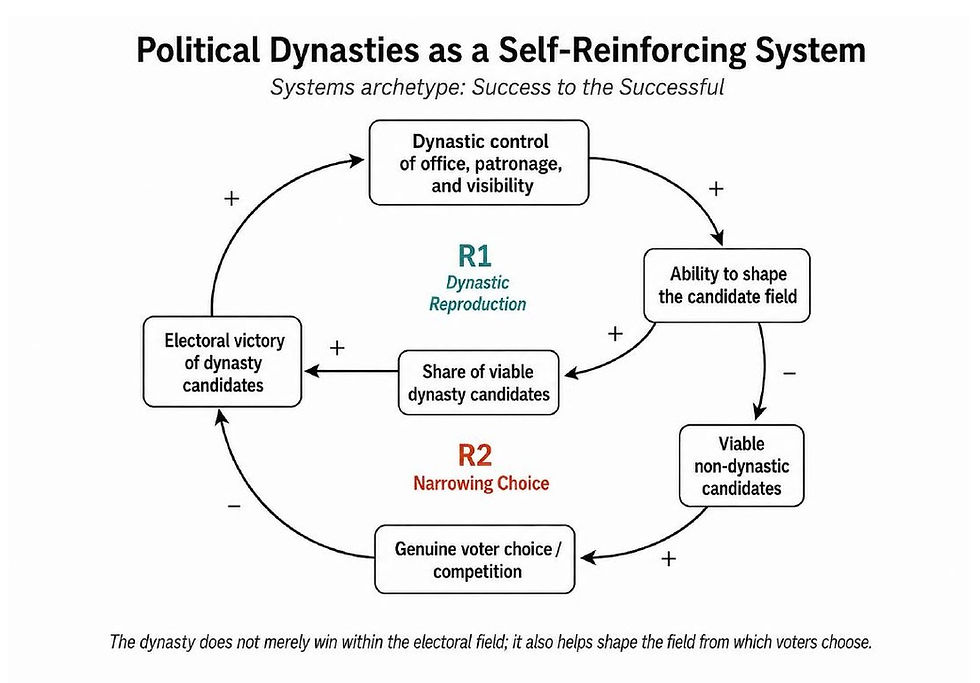
This creates a self-reinforcing cycle. In dynasty-dominated constituencies, political families can shape access to candidacy. They present relatives as the most viable—or only viable—choices. Voters select from the restricted field. The election result is then presented as proof that the family enjoys popular support. That victory further strengthens the family's control over the next election. The dynasty produces the choices, benefits from them and then claims democratic legitimacy from the choices it helped restrict.
The purpose of an anti-dynasty law is to prevent political families from monopolising the opportunity to be chosen. Meaningful voter choice requires meaningful candidate choice.
"I do not trust the groups collecting signatures"
Seventeen per cent of respondents said they did not trust the groups collecting signatures.
This is a serious message to D1L. It must introduce itself, establish its credentials, identify the people and organisations behind the initiative, account for its resources and explain how signatures will be collected, protected, submitted and verified.
This exposes an irony in representative democracy. Citizens are understandably cautious about giving their names and signatures to a civic organisation. Yet during elections, they delegate extensive lawmaking authority to politicians for three or six years—often with limited information about what those officials will do once elected and with few practical ways of requiring them to consult their constituents.
The survey therefore challenges both D1L and the political system. D1L must prove itself worthy of citizens' trust. But elected representatives must also stop treating electoral victory as an unlimited reservoir of public confidence.
"I am concerned about the use of my name, signature, or personal information"
Fourteen per cent were concerned about the use of their names, signatures or personal information. This is entirely understandable. A signature on a political petition is not ordinary administrative information. It connects an identifiable citizen to a political position.
Here, responsibility clearly rests with D1L. It must explain what information is being collected, why it is needed, who will process it, who may access it, how long it will be kept and what will happen to it after the initiative. It must assure citizens that the information will not be reused for partisan, commercial or unrelated purposes.
Privacy is not merely a regulatory requirement. It is a human rights obligation and a condition for democratic trust.
"I worry about political pressure or possible consequences"
Ten per cent of respondents said they worried about political pressure or possible consequences. This may be the most sobering answer.
The 1987 Constitution directs the State to guarantee equal access to opportunities for public service and to prohibit political dynasties "as may be defined by law." Nearly four decades later, Congress has yet to enact the law needed to make that prohibition effective. Political families have had decades to consolidate control over local governments, political organisations, economic opportunities and access to public assistance.
The fear of consequences is not imaginary. In a locality dominated by one family, signing a petition against political dynasties may be viewed as an act of opposition. Citizens may worry about employment, permits, contracts, social assistance, access to public officials or even their standing within the community.
This is why D1L's proposed mobile online sign-up system has democratic importance. A mobile system cannot make participation anonymous because a lawful petition must identify its signatories. But it can reduce their exposure to local intermediaries. Citizens may be able to sign privately without approaching a public table, being seen by local political operatives or handing their information to collectors within the locality.
Used properly, technology can create distance between citizens and the local structures capable of pressuring them. It can help protect participation while also making signing much more convenient.
What is this survey telling us?
This survey reveals a representative system in which citizens are rarely helped to understand the laws made for them; a candidate-selection system in which many choices have already been made before election day; a trust relationship in which politicians receive broad delegated authority while civic organisations must prove themselves one signature at a time; and a political environment in which some citizens fear consequences for participating in a lawful democratic process.
These weaknesses reinforce one another. Poor public understanding permits representatives to legislate with little scrutiny. Restricted candidate pools reproduce the same political families. Dynastic control deepens dependency and fear. Fear suppresses participation and makes reform more difficult.
A people's initiative can interrupt that cycle, but only if D1L performs the democratic duties that conventional politics has neglected: explain the proposed law, widen meaningful political choice, earn public trust, protect personal information and enable people to participate without unnecessary exposure to local political control.
The promise of the initiative is not simply that the people may make a law directly. Its deeper promise is that citizens may reclaim the understanding, choice and agency that representative democracy was supposed to preserve for them—but has too often taken for granted.
Notes:
The findings come from Pulse Asia’s nationwide sample of 2,400 respondents, with a reported national margin of error of ±2 percentage points. Fieldwork was conducted from 28 June to 3 July and on 6 July 2026.
About the Author
Telibert Laoc is a co-founding trustee of the Democratic Insights Group, a civic think tank working on competitive elections, voter-centered processes, and democratic representation. His work has spanned electoral integrity, citizen election observation, democratic reform and civil society development in the Philippines through the National Citizens' Movement for Free Elections (NAMFREL), and across Asia through the National Democratic Institute (NDI), a Washington, D.C.-based international organization. He actively supports Dapat 1sa Lang, a people's initiative seeking an anti-political dynasty law that would limit each family to one candidate for national office and one for local office at a time, covering relatives within the fourth civil degree of consanguinity or affinity.
Download a PDF version of the article below.