
When Voters Outnumber Residents

by Telibert Laoc | August 2026
For the 14 September 2026 BARMM Parliamentary Elections, the figures point to two connected concerns: voting arrangements that could make participation unnecessarily difficult, and differences between voter and population data that require reconciliation. Both can affect electoral integrity and public confidence in the elections.
Access to voting centers
COMELEC Minute Resolution No. 26-0346, Final Electoral Data for the 2026 BARMM Parliamentary Elections (2026), lists four Lanao del Sur municipalities with more than 5,000 registered voters per polling center. Tagoloan has two centers for 18,532 voters. Masiu has three centers for 20,253 voters; Marantao, six for 36,778; and Marogong, three for 15,346. Among all 108 municipalities in the BARMM reviewed by the Democratic Insights Group, the median is 1,960 voters per center and eight centers per municipality.
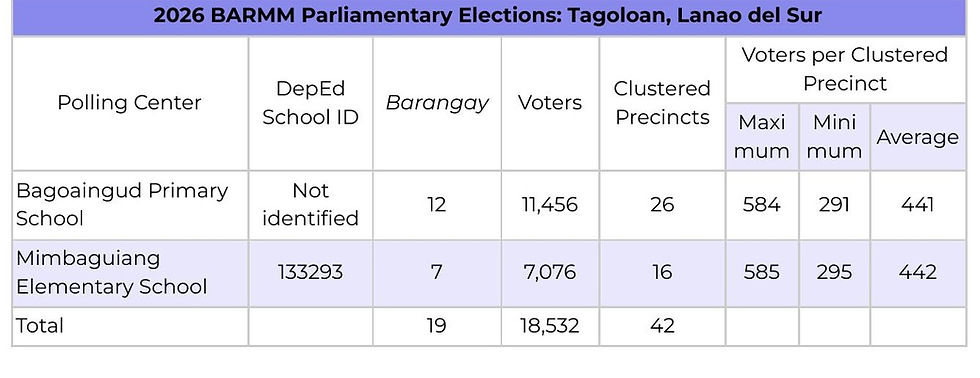
Two centers may simplify staffing and security, but concentrating so many voters in two locations also creates vulnerabilities. A delayed opening at either center, because of a security incident or a flooded route could affect a large number of voters. Travel cost, time and inconvenience could also discourage participation even without formal disenfranchisement.
This is a rights issue. Article 25 of the International Covenant on Civil and Political Rights protects every citizen's right and opportunity to vote without unreasonable restrictions. That protection is weakened when eligible voters cannot reach their assigned voting center safely and without unreasonable difficulty. The burden may fall most heavily on voters without private transport, older persons, persons with disabilities, pregnant voters, and women carrying care responsibilities or facing safety and mobility constraints.
Indicative travel access to Mimbaguiang Elementary School Polling Center
Mimbaguiang Elementary School Polling Center (DepEd National Inventory Dashboard) serves seven barangay: Cadayonan, Inodaran, Kianibong, Kingan, Maimbaguiang, Malinao, and Marawi.
Using COMELEC's official 2026 barangay-to-polling-center assignments, a desk review applied a provisional Geographic Information System (GIS) route model to the six outlying barangay. Maimbaguiang, the host barangay, was not measured. The estimates use representative barangay points, publicly available road data that may be incomplete, a proxy for the school's location, and assumed motorcycle speeds. They are intended only to identify routes requiring priority field verification.


The question, therefore, is "How far must each community travel? How much will the trip cost? Is the route safe and passable?"
Bagoaingud Primary School could not be matched in the publicly accessible DepEd directory
A review of the DepEd directory did not identify a Bagoaingud (or Bagoa-ingud) Primary School that could be confidently matched to the COMELEC-listed voting center in Tagoloan. There are four schools with similar names but they are in the municipalities of Ganassi, Bubong, Piagapo, and Saguiaran.
Population and voter figures
The population figures raise a separate but related question. Tagoloan's 18,532 registered voters exceed the Philippine Statistics Authority's official 2024 population count of 12,843 by 5,689, or 44.3 percent.
The updated DIG reconciliation, using COMELEC's 2025 Project of Precincts, finds 126 of 2,185 barangay across 42 municipalities or areas where registered voters exceed the PSA's 2024 population count. Barangay Malingon, in Tagoloan, Lanao del Sur has 354 voters per 100 residents and exceeds population by 254 percent. Barangay Kohec in the town of Sapa-Sapa in Tawi-Tawi has 275 voters per 100 residents, exceeding the population by 175 percent. Barangay Manggay in the town of Talitay, Maguindanao del Norte has 258 voters per 100 residents, exceeding the population by 158 percent. At the municipal level, the voter total is 44.3 percent higher than the population in Tagoloan, 11.7 percent higher in Turtle Islands and 5.1 percent higher in Lumbaca-Unayan.

The differences and the gaps could be attributed to different reference dates, migration and displacement, census coverage, boundary coding, and the updating of voter records. But because the population count includes children who are not eligible to vote, voters exceeding the entire population is important to explain. The responsible response is transparent verification.
What Election Stakeholders Should Consider Doing

The evidence points to two distinct tasks: make polling centers reasonably accessible and reconcile unusual voter-to-population figures.
Review Access to Polling Centers
COMELEC and the Bangsamoro Electoral Office should consider reviewing voting center assignments beginning with municipalities such as Tagoloan, where many voters are assigned to only a few centers. A barangay-by-barangay review should consider travel time and cost, terrain, road and transport conditions, seasonal weather, security, and accessibility for older persons and persons with disabilities.
In instances where it is not practicable, COMELEC should consider coming up with evidence-based templates or access benchmarks suited to urban, rural, island, remote, and conflict-affected settings to inform the designation of polling locations. A national situation-specific template for determining the location of polling centers would be similar to the concept of establishing accessible voting centers for indigenous peoples stated in COMELEC Resolution No. 11075 (2024).
Consider having a voting center in every barangay
Section 149 of the Omnibus Election Code requires at least one precinct per barangay. Section 154 requires a polling place 1 to be located as centrally as practicable relative to the voters' residences. A polling place in every barangay would not literally bring the ballot to each voter, as in the case of Tagoloan. But having a polling center in every barangay would bring the ballot substantially closer to the voter, which is a practical illustration of DIG's advocacy for voter-centered elections.
Reconcile Unusual Voter-to-Population Figures
The question is, under the continuing voter registration system what instances and what thresholds of percent of voters relative to the population would cause an automatic review? What courses of action should the COMELEC take, by itself or through the Election Registration Boards, to effect any corrections? To answer this the COMELEC, the Philippine Statistics Authority, and the local civil registrars should consider establishing a data-informed system to address the issue.
Observers also track voters' access to polling centers
Accredited citizens' arms and nonpartisan election observers should consider examining voters' access to polling centers in their election observation system. In places where access is a potential issue, they could interview voters and/or run online surveys looking at voter pain points such as distances, time, and cost on voting day and before. The data collection should allow disaggregation by sex, age, disability status, and other relevant information, such as terrain, climate hazards, and availability of public transportation.
Observers and COMELEC monitors should also consider documenting any attempts by candidates, local officials, armed groups or other actors to control access to polling centers.
Other data and references
COMELEC: 2026 BARMM Parliamentary Elections—official election materials, including municipal figures and voting-center assignments.
DIG voter-population reconciliation spreadsheet—barangay and municipal comparisons used in the analysis.
Omnibus Election Code (1985), Sections 149 and 154—establishment of precincts and location of polling places/centers.
Republic Act No. 8189 (1996), Sections 36 and 39—voter verification and annulment safeguards.
COMELEC Resolution No. 11075 (2024)—accessible voting arrangements for Indigenous Peoples.
Notes:
A polling place is defined by Republic Act 8198, Voter’s Registration Act (1996) as “the place where the Board of Election Inspectors (now referred to as Electoral Board) conducts its proceeding and where the voters cast their votes)


